
Sydney Sandstone Excavation: When to Rock Saw vs Hammer Near Boundaries
How low-vibration diamond rock sawing protects neighbouring Sydney walls, lowers dilapidation risk, and cuts concrete over-pour costs.
Across Sydney's Eastern Suburbs, Lower North Shore, CBD, and Inner West, excavation almost always meets Hawkesbury sandstone. Choosing the wrong breakout method near a boundary wall or heritage terrace is one of the fastest ways to trigger vibration complaints, dilapidation disputes, and blown basement budgets.
Why Hydraulic Hammering Alone Carries Boundary Risk
A hydraulic rock hammer breaks sandstone through repeated percussive shockwaves. In open commercial paddocks away from structures, hammering is fast and economical. However, when cutting within 1 to 3 metres of a neighbouring brick wall, shared footing, or heritage sandstone foundation, percussive vibration travels directly through solid bedrock into adjacent structures.
Most Sydney geotechnical reports and council DA conditions enforce strict Peak Particle Velocity (PPV) vibration limits under DIN 4150-3. Exceeding those limits stops the site immediately until a structural engineer inspects the adjoining property.
How Diamond Rock Sawing Solves the Problem
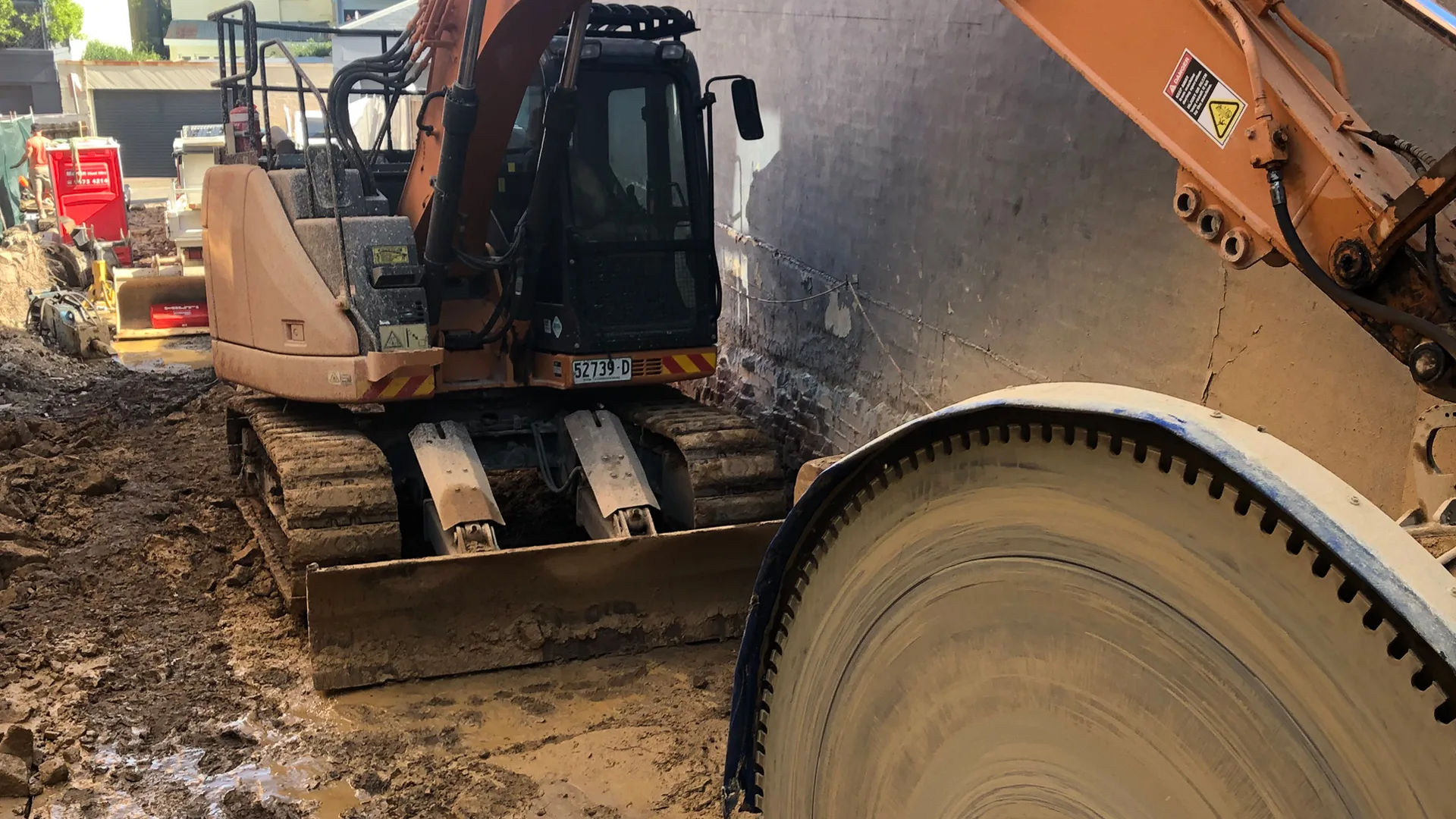
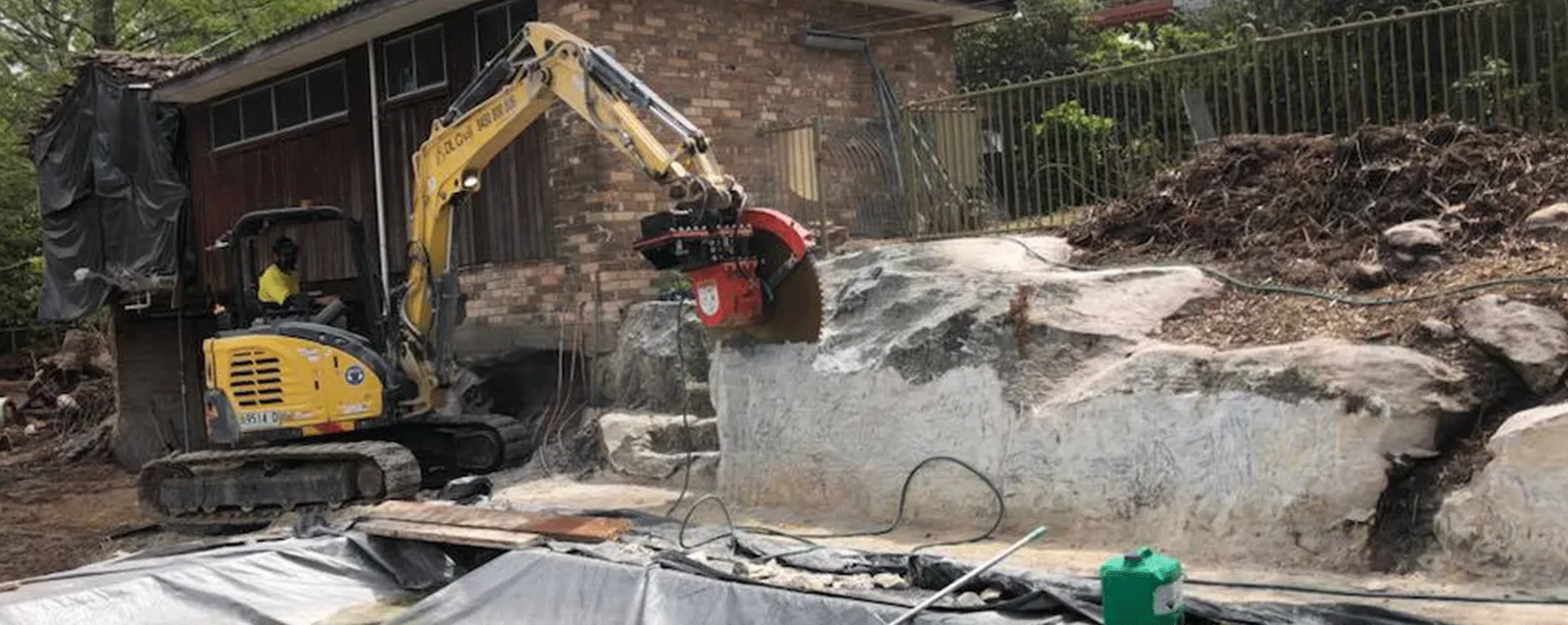
Excavator-mounted hydraulic diamond rock saws slice clean, continuous vertical relief cuts through sandstone using rotational cutting rather than impact shock. By saw-cutting the perimeter boundary first, DL Civil creates a physical air gap that isolates the neighbouring structure before internal rock is broken out.
- Drastically lower ground vibration: Helps builders stay safely inside geotechnical PPV monitoring thresholds.
- Razor-straight vertical faces: Eliminates jagged rock over-break, saving thousands of dollars in wasted concrete, shotcrete, and formwork.
- Wet silica dust suppression: Continuous water feeds suppress airborne crystalline silica in line with SafeWork NSW WHS requirements.
When to Add a Rotary Rock Grinder
After perimeter sawing and bulk hammering, rotary rock grinders (profilers) trim final basement walls, lift overruns, and footing pockets to exact millimetre tolerances. Combining saw, hammer, and grinder under one owned fleet means zero downtime waiting on third-party attachment hire.
Planning Your Sandstone Cut in Sydney
Before mobilising to any sandstone job, confirm three items: a current Before You Dig Australia (BYDA) check, a pre-construction dilapidation report if cutting near neighbouring walls, and an accurate spoil weight allowance. Loose broken sandstone weighs roughly 1.55 tonnes per cubic metre, meaning a 6x4 bogie tipper hits its legal NSW GVM payload around 7.5 to 8 cubic metres rather than a full 10m3 bin.
Use our Sydney Spoil & Machine Calculator to estimate weight-capped tipper loads, or send your geotechnical report to DL Civil dispatch for a fixed-price rock scope.